Showing posts with label Food World. Show all posts

Saturday, February 21, 2026

The Food World of the 21st Century


Food World #715 / Publix #356 / Publix #2043
4730 S. Florida Avenue, Lakeland, FL - Lake Miriam Square

Today's post is a presentation of Polk County retail

     While February may have gotten off to a cold start for most Floridians, things are just starting to heat up here on AFB! For my second feature post of the year, I'm going to present everyone with an update to a store we toured about a year and a half ago - the Lake Miriam Square Publix (not to be confused with the Lake Miriam Crossing Publix across the street - gotta love those redundant Publix stores!). Sadly, the storied Publix location that had stood at this site for nearly 50 years closed for a complete demolition and rebuild in July 2024, and we'll use today to take a look at its replacement now that it has reopened. While most modern Publix stores aren't anything super exciting or noteworthy, typically following one of six standard templates that rarely see much modification, Lake Miriam's replacement was actually one of the more interesting (and rare) of Publix's modern designs - a design reserved for particularly special (or high-end) locations in the chain. Being the replacement for the chain's flagship store, of course Publix pulled out its best for this project, and we'll be seeing the new flagship design for the first time today on the blog. Called the "55M" on internal material due to its 55,000 square foot size, the new store isn't much larger than the building it replaced, but it does keep true to the old store's flagship status by offering pretty much every extra Publix has under their belt these days. But enough of this intro stuff, let's take a look at the new store!
     

     Before getting too deep into this post, if you haven't seen my coverage of the original Lake Miriam Square Publix (store #356), please check out my post here. That post goes into all the detail about this store's history, including its origins under the Food World brand, its piloting of various unique features through the years, and its unique layout stemming from a rare building design Publix only used two other times. My coverage of the original store turned out to be one of my most popular posts of all time, exceeding view counts of most other posts I've written in the last few years by quite a large number. People really loved that old store based off the view count (either that, or the refresh button on someone's computer got stuck on that page), so I wanted to make sure I had the full story of this Publix covered by visiting the new location once it opened (that, and I'd never been to a 55M Publix, so I wanted the full experience myself!).


     The facade of the new Lake Miriam Publix isn't anything out of the ordinary compared to most other modern Publix stores, with many other locations having a very similar exterior to what we see here. As we'll see a little later in the post, the remainder of Lake Miriam Square had its facade refreshed to match the new Publix store, giving everything a consistent look.


     The windows above the arches look into the upper-level dining area, a commonality shared between the 55M Publix stores and its much more common sibling the 48M, Publix's default prototype (which has officially been retired as of 2026 in favor of the "50M", which from the customer-facing side, is practically identical to the 48M).


     Looking down the front walkway, the main entrance is visible just beyond the Presto! ATM machine. The door closest to me (at the end of the tables) is the patio door for the POURS bar, the outdoor seating area for which I was standing in to take this picture.


    Stepping inside, we're welcomed to the store with the large sign on the wall - green bean free these days (although old #356 actually featured the rare grape-background welcome sign). While I took this photo to showcase the sign, this photo also serves to showcase the unusual shopping carts this store received, with the tall child seats and low baskets. These carts are apparently exclusive to the more-recently opened stores that receive a POURS, as they have a large built-in cup holder (and phone stand, which was convenient for photo taking purposes!).


     Stepping inside, the grand aisle is located on the right side of the building. The first departments you see upon entering are the produce department and the deli island. From this view the store doesn't look much different from a 48M or even the smaller 28M, but things begin to get much more different as we progress further into the grand aisle, and even once I turn around:

There's a special surprise in this store, visible in this photo, and unique to this location. We'll talk more about that later!

     Also near the front doors, the catering desk and the POURS cafe greet shoppers entering the store, both of these features not present in the typical 48M. The catering counter was just a small desk with a computer located right under the sign, with POURS and its interior dining area taking up the majority of the alcove we see here. 


     Even though POURS sells coffee, as well as other non-alcoholic alternatives like tea, craft soda, and smoothies, the main attraction of POURS is the bar with beer and wine on tap, available as a sip-and-stroll option (hence the special carts with the large cup holders). At 9:00 in the morning, the bar was certainly not hopping, but people were walking up to the counter to order some of the less potent drink options for a morning kick (and there may have been a few opting for the other kind of morning kick too, but it seemed like coffee was much more popular this time of day from the drink cups I was seeing in carts around the store!).


     Leaving POURS, we see the rest of the produce department, located in front of the deli island. 


     The deli island is where the 55M's uniqueness really begins to shine, as what sets the 55M apart from Publix's other prototypes are its emphasis on ready-to-eat and prepared foods. Unlike the 48M, which has its entire deli operation inside that island, the 55M's island is devoted to only prepared foods - the "typical" deli counter with the case of cold cuts is located behind the island on the back wall.


     Looking down the right side wall, the traditional deli counter with the sliced meats, the Pub Subs, and the typical hot foods selection (fried chicken, etc.) is partially visible, as well as another unique 55M feature in the back right corner we'll discuss in a little bit too. However, before we get to the more traditional fare on the back wall, let's turn our attention back to the island:


     While everyone loves a Pub Sub, Publix really ups their prepared foods game in these 55M stores with the broadest selection of prepared foods offered by the chain under one roof. Within the island, the front side facing produce features sushi, with the right side featuring the burrito stations (think Chipotle-esque fare) and the left side featuring pizza and pasta. The back of the island is the specialty cheese case. The photo above focuses on the burrito bowl side of the island, with part of the sushi counter poking out.


     Turning away from the island for a moment, in the back right corner of the store next to the traditional deli counter is the fresh popcorn counter. While most Publix stores offer fresh-popped butter popcorn from the deli (and occasionally plain in some stores), the 55M has an entire counter dedicated to fresh popcorn in a variety of flavors (caramel corn, kettle corn, cheddar, etc.) pre-packaged in various sizes and variety packs. While burrito bowls and pizza are nice, many supermarkets have experimented with such features before. These Publix stores are the only major supermarkets I know with a special popcorn counter! 


     Adjacent to the popcorn counter is the traditional deli counter, as mentioned before. While nothing too out of the ordinary selection-wise, this store did open with Publix's new expanded self-service hot case, where most of the fried chicken and sides come pre-packaged rather than ordered from the usual deli line. Those cases have been a source of controversy from Publix purists, who say the products are better when packed fresh instead of sitting in the pre-packs under the heat lamp for hours, in addition to other issues.


     The bakery is located to the left of the traditional deli counter, in a much more logical placement compared to its isolated home on the opposite side of the building in the 48Ms! Other than the better placement to be included in the grand aisle, the bakery selection isn't any more grand than you'd find in any other Publix out there. The only special features I saw here were the inclusion of the bakery hot case (which holds the empanadas and breakfast sandwiches - the case located directly in front of me to the left of the donuts). And speaking of the donuts, the self-service case also looked a bit larger than normal.

Yes, the store across the street is just a more cramped version of this now.

     With the bakery not being anything too out of the ordinary, let's turn our attention back to the deli island. The left side of the island, visible above, is home to the pizza and pasta station, with the salad bar and hot bars located in the aisle out front. If this scene looks familiar to you, you may remember the similar layout from the former Greenwise across the street. Essentially, the 55M's grand aisle and special features are an exact copy of everything piloted in the Greenwise 2.0 stores. Since the retirement of the Greenwise-standalone brand, the 55M has picked up where Greenwise left off, just expanding it into a full-sized supermarket. It's nice to know that Greenwise's short tenure was not a total waste and its special features proved viable for something, and I think these 55M stores are actually a nice evolution for the Greenwise brand.

     Anyway, on a different note, one of my goals stemming from a visit to a 55M Publix was to finally try the elusive Publix deli pizza, only offered in these stores and the former Greenwise locations. However, I visited this store at 9:00 in the morning, and the prepared foods island doesn't begin full operations until 10:00 per the girl working the pizza station. As such, the pizza bar (and everything else in the island) was empty during my visit, and I didn't have the time to wait around until 10:00 to try a slice. Oh well, this store isn't going anywhere anytime soon and I'm sure I'll be in Lakeland again eventually, so one of these days I'll get to try the Publix pizza!


     Leaving the grand aisle, I would like to comment that there was one major prepared foods feature from the old store we didn't see in the new one, as even with all the fancy new options, this store did not bring back its Chinese food counter (which was extremely popular, per many posts from people begging for that to make a return once the new store opened). While we didn't see the Chinese food counter in our tour of the grand aisle, there is an interesting (and happy) ending to those shopper's requests, and we'll discuss that more a bit later. Anyway, with prepared foods behind us, here's a look across the store's back wall, home to the dairy department. The special features of this store begin to fizzle out as we enter the main grocery aisles, with this portion of the store being home to Publix's standard fare.


     This store had been open for well over a month by the time of my visit, but the shelves were still stocked and blocked to a grand opening standard. However, a 30-year-old Publix will look this neat and spotless most days too, but it's much more striking of a scene in a store as new as this!


     International foods, as well as a selection of small appliances, were for sale here in aisle 2.


     Back up front, here's a look toward the store's front end. It looks like I never got a very good photo of it, but floral was located in an island at the front end next to the self-checkout lanes, with the regular check stands and the pharmacy located in the distance beyond those.


     In the center of the salesfloor are frozen foods, located in aisles 7 and 8.


     Publix stores placed a snowflake decal on the top of the cooler doors last Christmas season, which was a nice touch. Even though the snowflakes were just there to promote the merriment of the Christmas season, I feel like a snowflake decal is a good decoration for these doors year-round!


     Following frozen foods, we find soda and beverages in aisle 9.


     The soda aisle is followed by a few non-foods aisles, with paper goods, foil pans, and Ziploc bags pictured above. In the background we see the meat and seafood counter poking out, located in the store's back left corner.


     Here's a nice overview of the meat and seafood service counter, located on a slight angle in the back left corner (almost in the style of a mid-1990's Albertsons store).


     The meat and seafood service counter is located in the position where the bakery would go in the more common 48M/50M model - those two department essentially trading places in this store. I think meat and seafood make more sense to be in this corner than the bakery, which comes across as so out of place back here.


     Returning to the grocery aisles, aisle 12 has to make its appearance, home to cleaning products.


     Aisles 14 and 15 are primarily home to beer and wine, with the exception of the greeting card/party supply merchandise in the center back of these aisles. While that arrangement sounds a bit strange at first, it makes for a convenient placement for a last-minute anniversary or Valentine's Day gift!


     The coolers we saw in aisle 14 housed most of the store's beer selection, with wine located here in aisle 15 as well as on the shorter shelf in the upper half of these aisles.

Photo courtesy of Publix

     Being Publix's top of the line prototype as well as the chain's flagship store, this store did receive the locked cabinet of really expensive wine too. I totally missed seeing this during my visit (as buying a $500 bottle of wine isn't something on the top of my mind), but thankfully Publix took a picture of the case for their grand opening photo spread! Looking at the prices, a $345 bottle of Joseph Phelps Insignia (a winery, which according to this article, is owned by the parent company of Louis Vuitton) is the price to beat - actually one of the cheaper top wine prices I've seen in one of these cases.


     Around the corner from the pricy wine case, we find the store's lunch meats and PB&J supplies - products a bit more in my price range!


     In the photos of the beer and wine aisle, we saw the store's pharmacy counter, located in the front left corner of the building. It appears I didn't get a close-up shot of that either, but it's a typical modern Publix pharmacy located in the same place the pharmacy goes in every one of Publix's new stores. The pharmacy was located just behind me in the above photo, which looks across the store's front end. This store's front end isn't anything too out of the ordinary either, until we return our attention to the front wall to look at something unique to this location:


     You're eyes aren't playing tricks on you - that's an original Pati Mills tile mural installed inside a Publix opened in 2025! While this store is new, the mural actually isn't - Pati Mills (who is actually still alive - she will be turning 90 in 2026) hasn't made a mural for Publix since the 1990's. The mural we see here was actually removed from the front of the Grove Park Shopping Center Publix on the other side of Lakeland before it was demolished and rebuilt in 2018. Publix took the mural and put it into storage for the last 8 years, before deciding to incorporate into the front end of Publix #2043.

Photo courtesy of Publix

     Sadly, during my visit here, the store's self-checkout attendant was spending his time standing in front of the mural, so it was hard to photograph without getting his attention. Thankfully after I finished checking out at one of the staffed check lanes, the self-checkout attendant left his post in front of the mural to help a customer, giving me an opportunity to grab the photo you saw previously. However, the inclusion of the mural into this store was a big enough deal that Publix themselves took a nice picture of it to include with the grand opening album (seen above). Once I get around to posting it, I will have more photos of this same mural in its original home at the store on the other side of town as well!

     Seeing one of these old Pati Mills murals reappear in this store seems to suggest Publix has, in fact, been saving these murals from stores being rebuilt over the last few years, even after telling the public they could not be saved/were too difficult to save for many years prior. Since the Grove Park Publix was rebuilt in 2018, I have confirmed 3 instances where additional murals were removed from a building before it was demolished, including this situation I posted about a few years ago. I was wondering who was taking the effort to save the murals, and it seems after so many years of letting these murals become rubble, Publix had a change of heart following the closure of the Grove Park store. Being that Publix has at least 3 more murals in storage somewhere, I wonder if we'll see more murals reappear if the circumstances lend themselves? With #2043 being the new flagship it made sense to see a mural appear here (even though old #356 never had one), but it would have been nice if Publix just incorporated the murals salvaged from an old store back into its direct replacement!


      Before I could leave, I had to check out the store's upper level dining area. This store's dining area isn't anything too different from what you'd find in one of its smaller 48M/50M siblings, but you all probably aren't as interested in looking at these tables and chairs as you are wanting to see photos looking out over the salesfloor from this heightened perspective - the best part of these dining areas:


     Here's a look toward the right side of the store and the grand aisle - it looks quite grand from this angle!


     Frozen foods were located directly below where I was standing. Thankfully this store was only a little over a month old when I took these pictures, as I can only imagine that in a few years, there will be a lot of dust accumulating on top of those coolers!


     Here's what I was able to capture of the left side of the store - the mezzanine continues off to my left, but beyond the stairs/elevator it turns into an employees only corridor home to their break room and some offices. 


     Back downstairs, here's another look across the store's front walkway toward the outdoor dining area for POURS. While some Publix stores have an outdoor portion to the upstairs dining area, this store did not have that feature, with these tables on the front walkway seeming to make up for that.


     A new feature for this location was the attached liquor store, located in the storefront adjacent to the main supermarket. The Publix Liquor Store at Lake Miriam Square is technically a relocation of the liquor store that was attached to the former Greenwise across the street. Due to the store across the street being located in unincorporated Polk County (which does not allow liquor stores to be open on Sunday) and Lake Miriam Square falling within the bounds of the City of Lakeland (which does allow Sunday liquor sales), Publix chose to move the liquor store here during the rebuild to take advantage of the Sunday sales.


     Even though the liquor store is now over here, other than this store being double the size of the one across the street, there isn't much of a different between the two stores in terms of features. Being a former Greenwise, the store across the street has both a POURS and the expanded prepared foods options seen here, so Publix can't even justify the close proximity of these stores by stating the they have different features. It really comes down to if you want sip and stroll at big Publix or small Publix! With this store reopened, I wonder which store is more popular - the big one or the small one. This store was crazy busy before it was rebuilt, but the store across the street was also really busy the last time I was there (which was right before this one closed for the rebuild). It's Lakeland though - they probably both print money!


     In coordination with Publix's rebuild, the remainder of Lake Miriam Square received a facade refresh. Moving down the strip, here's a look at the old Wilkor space post-remodel - to compare, see it's original form here.


     Even though the former Wilkor has been subdivided into smaller spaces for a number of years now, the store's large windowed facade and raised ceiling over the walkway remain today. That set of doors in the center of the windows looks like it could be original too!


     At the southern end of Lake Miriam Square, we find the rather generically named "Chinese Kitchen" per that exterior sign. Officially named the Lake Miriam Chinese Kitchen, this restaurant opened in April 2025, 9 months after Publix closed for its rebuild. Realizing how popular its "Chinese Cuisine" counter was in the original store and knowing that feature didn't make the cut for the new one, the operator Publix contracted with to run the old in-store Chinese cuisine counter decided to build this stand-alone restaurant to carry on the tradition from the old store. The menu served here is identical to what Publix offered (and may have even expanded slightly too), so the fans of that offering just have to walk to the other end of the plaza for their Chinese food fill! With all the food options in the new store's grand aisle (including an entire spread of sushi), it would have been nice if Publix could have incorporated the old Chinese Cuisine counter into the sushi area somehow, but at least the Chinese food didn't go away completely.


     As sad as it was to see a Publix as significant as store #356 succumb to the wrecking ball, at least Publix brought the company's best and most deluxe modern prototype to Lake Miriam Square to carry on this location's tradition as the company's flagship store. I was happy to see one of these deluxe modern Publix stores myself, considering how elusive they seem to be (outside of Kentucky, anyway - Publix is really pushing this 55M design with most of their new locations in Kentucky). One off these days I'll have to return to try the pizza, so I'm sure this won't be my last time seeing a 55M!

     Anyway, that completes the story of the Publix at Lake Miriam Square, from Food World to the Food World of the 21st Century. So from a top of the line Publix to a funky Publixsons, AFB will return in two weeks with more!

Until the next post,

The Albertsons Florida Blogger 

Sunday, November 10, 2024

Former Albertsons #4374 - Tampa, FL (Britton Plaza)


Publix #34 / Food World #708 / Publix #267 / Albertsons #4374 / Publix #1307 / Publix #1506
3838 Britton Plaza, Tampa, FL - Britton Plaza

Today's post is a presentation of Hillsborough County retail

     "What's Old is New Again" - that headline certainly applies to the store we're about to see today! I like to call the story of Albertsons #4374 "the tale of Albertsons and the 5 Publixes", a nod to one of the most convoluted retail lineages of any store I've come across in Florida. On AFB and MFR, we've had our fair share of strange store histories through the years - for example, a Winn-Dixie that got kicked out of a building and later reopened in the same spot almost as if it were an act of revenge, long strings of failed concepts under one roof - we've seen a lot through the years! Here at Tampa's famous Britton Plaza, a South Tampa staple since 1956, this shopping center has housed 5 various incarnations of Publix over the last 68 years, with Albertsons holding down the fort for 19 of those 68 years during Publix's absence from the plaza. Not only does Britton Plaza hold the record for number of Publix stores to have stood in the same spot over the years, but the fact that Albertsons ended up in the mix just adds to the intrigue. On top that, Britton Plaza is also one of the most iconic shopping centers in Tampa, and has a long history in its own right. All that said, there's a lot to talk about today as we explore the history of Albertsons #4374 and Britton Plaza as a whole. This is going to be a long post, but I think you all will like this one, even if our former Albertsons of the day isn't the most exciting Publixsons anymore. With a number of AFB readers hailing from the Tampa Bay area and the notoriety of this shopping center, I wouldn't be surprised if there were a few readers who have been waiting for me to cover this store in some form. Anyway, let's jump into our background by going way back to 1956 to learn more about Britton Plaza's early days:


     In the mid-1950's, South Tampa was abuzz with development as post-war suburban housing began engulfing the peninsula situated south of Tampa's downtown core. Driving a lot of that development in South Tampa was the establishment of MacDill Air Force Base, one of Tampa's largest employers post-war (and even to this day). Constructed during World War II as MacDill Field and renamed MacDill Air Force Base following creation of that military branch in 1947, MacDill became home to the Strategic Air Command's fleet of B-47 Stratojet Bombers as the nation entered the Cold War, a critical component of the nation's military infrastructure at the time. With the military's growing installation and the migration of residents out of Downtown Tampa and Ybor City in favor of newer suburban developments, South Tampa was in need of some new stores to serve its new residents. To serve as South Tampa's retail hub, plans were created in 1955 to construct a 300,000 square foot destination shopping center on 32.5 acres along South Tampa's main north-south thoroughfare: South Dale Mabry Highway. This new shopping center, touted as the largest in Florida when it opened, would feature 33 stores selling a broad array of merchandise. In addition to Britton Plaza, its developer, W.H. Toole, Jr., was also developing the large Northgate Shopping Center in North Tampa. These ambitious retail projects, were two of the largest in the nation at the time, and would later serve as a model for future retail developments planned around the country. Mr. Toole saw Tampa as having a large potential for growth, so he was going all-in with his new shopping centers, which were a relatively new concept in the mid-1950's.


     Most early Floridian shopping centers from the 1950's, like Southgate in Lakeland, were modest endeavors typically featuring a grocer, a drug store, a 5 and 10, a department store, and some smaller shops mixed in. Publix in particular was an early adopter of the shopping center model, with new stores in shopping centers being a focus of growth for the chain in the 1950's. Britton Plaza, like its sibling Northgate, were taking the revolutionary shopping center concept to a new level with their large sizes - essentially bringing the traditional stores of downtown into a central location with all the highlights of suburbia: ample parking, air conditioned stores, and a wide selection of popular chains to choose from. Britton Plaza was a hit from the start, and even with some ups and downs through the years, has remained as the hub of commerce for South Tampa.


     Construction of Britton Plaza took about a year, and according to this article, building such a large shopping center was no small undertaking. The article above had an interesting way of breaking down the construction of Britton Plaza and conveying its size, stating that it took 600 union workmen, "572,000 concrete blocks, 5,000 cubic yards of concrete, 225 carloads of lime rock, 3,500 tons of asphalt, 2,500,000 pounds of steel, 35 carloads of plaster materials, 18,000 feet of prestressed concrete pilings, 30,000 cubic yards of fill dirt, and miles of drainage pipe. Enough concrete blocks were used to build 250 average-sized two bedroom homes." Breaking it down that way, it makes this 9,000 piece Lego set not seem so bad, right? While the original plans called for 33 stores, upon its opening, Britton Plaza ended up featuring 42 stores, with room for an expansion to add 8 more. The 25 acre parking lot could handle 2,200 cars, with 9 city blocks of storefronts all in a row. And if you're into local lore, there's also a legend that's been passed around about Britton Plaza too - supposedly during construction, a bulldozer sunk into the mud and crews decided to leave it in the ground and build over it rather than retrieving it from its murky grave. I don't know how true that story is, but it's fitting that such a famous shopping center has some lore attached to it!


     August 16, 1956 was the big day for Britton Plaza - the day of its grand opening. That morning at 9:00 a.m. the ribbon was cut for 38 of the center's 42 stores, the remaining stores opening in the days after. Thousands were expected to show up for Britton Plaza's opening ceremonies, which included a whole schedule of pomp and circumstance including an invocation by the MacDill Air Force Base Chaplain, presentation of the colors, speeches by the Chamber of Commerce president, the developer, the contractors, and Tampa's mayor J.L. Young, who would serve as the designee to cut the ribbon. Britton Plaza was to offer a little of everything to South Tampa shoppers, although the new movie theater (which we'll talk about more later) was considered one of the main draws to the new shopping center (being Tampa's largest theater at the time of its opening). A description of the movie theater takes up most of the grand opening article, which also goes into detail about the plaza's other original tenants as well, such as Publix, W.T. Grant's, J.C. Penney, Madison Drug, Thom McAn, Western Auto, A.S. Beck Shoes, National Shirt Shops, Neisner Brothers, Fabric Mart, and many more.


That's one-third mile of storefronts you see here, in this pre-grand opening overview of the shopping center taken from within its 25 acre parking lot.

     While the article goes into a lot of detail about all the stores in the shopping center, I will highlight the part about the new Publix, store #34, from the article, since Publix (and the Albertsons that replaced it) is the primary subject of this post:

     Probably the biggest money-maker at Britton Plaza will be the Publix Supermarket, another one of a huge chain operated by George Jenkins of Lakeland. James Smith is manager of the store, the sixth opened by Publix this year.

     Convenience is offered the minute the customer enters the store, where an electric eye opens the door automatically.

     Shoppers are greeted by a sunburst of light and color. Each wall is painted a different pastel shade, particularly pleasing to the woman shopper. Sound-absorbent ceilings cut noise to a minimum, and the quiet is broken only by the sound of soothing music, piped from hidden ducts in the wall.

     The store is completely air conditioned, aisles are wide and spacious for easy movement of carts, and foods are arranged for easy selection.

     The ultimate in self-service will be provided by the store's huge meat and frozen food cases, 100 feet in length, the 88-foot produce case and the 50-foot dairy department case.

     An innovation is a complete housewares department, where the housewife will find many new, labor-saving household items.


     As you can tell from that description, the new Britton Plaza Publix was quite the fancy offering for the time, with its expansive meat, frozen foods, and houseware offerings. Frozen foods in particular were a big innovation in the 1950's, especially following the launch of the Swanson "TV Dinner" in 1954, which is credited in turning frozen foods (and in particular "ready meals") into a national phenomenon. Frozen "ready meals" were another 1950's invention designed to make the life of the housewife easier, and interestingly, Publix's overall goal with the new Britton Plaza store was to appeal to that particular housewife shopper, as George Jenkins himself explained in this article:


     Described by the Saturday Evening Post as "The Grocer all the Girls Love", George Jenkins described how appealing to the housewife was the key to a successful supermarket in the mid-1950's:

     "A housewife", says Jenkins, "is a person of delicate sensibilities. She doesn't like noise, dirt, crowding or disarray. She particularly doesn't like to hunt for a place to park, for when she stops off at the store to buy her groceries, she has already done 40-odd chores that morning and still had 40 other things to do."

     Jenkins "thinks like a housewife" before every new Publix Market is erected. He selects a site away from heavy traffic in the center of town, so there will be adequate free parking.

     He landscapes the grounds with palm trees and flowering shrubs, and he builds covered breezeways from the parking area to the store entrance for protection from sudden Florida showers. An electric eye opens the door of the store automatically, so a Publix patron can carry her bundles or a baby without a touch of a knob.

     The site selection process for stores has always intrigued me, so I though this snippet from George Jenkins himself explaining the process as it worked in the 1950's was quite interesting. With the housewife being the primary grocery shopper at the time, it made sense to tailor the store to her appeals. However, designing a store with plenty of parking and a non-chaotic atmosphere has plenty of appeal to shoppers across the board, even today!

Photo courtesy of Douglas K.

     Throughout the last few newspaper clippings, we've seen a number of photos of the original Britton Plaza Publix from the 1950's, showcasing its classic Wing Store design (and you can see some additional photos of its Time-O-Matic neon sign here). From its opening in 1956 until 1972, this Publix didn't change all that much. However, come late 1972, a big change was in store for the Britton Plaza Publix:


     While Publix in modern times is no stranger to having a number of stores within a close proximity to each other, Publix had built up a tightly clustered grouping of stores in South Tampa along the Dale Mabry corridor. In addition to Britton Plaza, that group included store #23 a mile to the south of here at Gandy Shopping Center, and store #17 two miles to the north at the Dale Mabry Shopping Center (both of which still exist as Publix stores to this day, although rebuilt multiple times). Sandwiched between those two stores, the Britton Plaza Publix was chosen for conversion to Publix's new Food World discount concept, because, per Publix President Mark Hollis, the Britton Plaza store "[has] not reached [its] full potential". Alongside the Britton Plaza store, its sister location at Tampa's Northgate Shopping center was also selected for conversion to Food World at the same time, those two stores debuting the Food World concept to the Tampa Bay area.


     Publix #34 closed in October 1972 for a weeklong conversion to the Food World brand, where the signage was swapped out, new price tags were hung, and the interior of the stores were repainted from Publix green to Food World blue. Food World #708 at Britton Plaza opened for business on October 24, 1972, featuring the brand's lower prices and lack of gimmicks (like the distribution of S&H Greenstamps). 

Food World's spinning globe sign in all of its glory!

     Publix expanded the Britton Plaza Food World store into two neighboring storefronts in 1982, coinciding with a small revitalization effort to Britton Plaza following the construction of newer shopping centers nearby in the early 1980's. While Britton Plaza was able to evolve, Food World, however, was nearing the end of its lifespan by that time. Like many of Publix's offshoots, as time went on, the features that made Food World different from Publix began to blur as the stores started to become more Publix-like in operation. With the concept seemingly winding-down by the early 1980's, it was announced in September 1984 that the Hillsborough County Food World stores, including the locations at Britton Plaza, Northgate, and two newer stores, would all convert back to the Publix branding. The conversions took about two months, with the converted Publix stores all opening in October 1984.


     While most of the remaining Food World stores that survived into the early 1980's were converted back into Publix stores, a large number of them didn't survive very long in their new forms. A high percentage of these Food World to Publix conversion stores closed outright after a few years, superseded by other newer Publix stores nearby, while others were swiftly replaced by new stores nearby (as many Food Worlds were located in dated 1950's and 1960's Publix buildings). Much like the situation that caused Publix to convert the Britton Plaza store into a Food World in the first place, the new Publix #267 was sandwiched between those same two stores mentioned before, however, with those other two taking on new characteristics by the late 1980's. During its time as Food World #708, Publix #17 up the street had been rebuilt in the late 1970's into a larger store, and #23 to the south was preparing to be rebuilt into Publix #310, a store featuring Publix's latest deluxe prototype. The new Publix #310 opened in 1986, and wound up indirectly replacing Publix #267 as well. Publix #267 only overlapped with #310 for a year before it closed on July 11, 1987. With store #267 being a slightly expanded 1950's Publix Wing Store operating a mile away from Publix's highest-end 1980's prototype, I think that swayed Publix to move on from Britton Plaza - at least for a slight gap period.


     With the rise in construction of indoor shopping malls in the 1970's and 1980's, Britton Plaza began facing more competition, especially from the WestShore Plaza Mall just a few miles to the north, as well as other new malls and shopping centers being built throughout Tampa. While still maintaining a respectable amount of stores to serve the neighborhood, the closure of Publix in 1987 was seen as a large blow to Britton Plaza, especially after losing JCPenney earlier in the 1980's to the new East Lake Mall on Tampa's eastern fringe. However, the owners of Britton Plaza and the remaining tenants still saw a bright future for Britton Plaza, even with the challenges the center was facing in the late 1980's. Come 1989, Britton Plaza announced a huge win for the center - the signing of a lease with a new grocery anchor, Albertsons, as well as bringing in Stein Mart to fill the void left behind by JCPenney. As part of the construction of the new Albertsons store (which would occupy the part of the plaza where the Publix building once stood, in addition to a number of storefronts around it), the entire shopping center's facade would be renovated, ushering Britton Plaza into a new era.


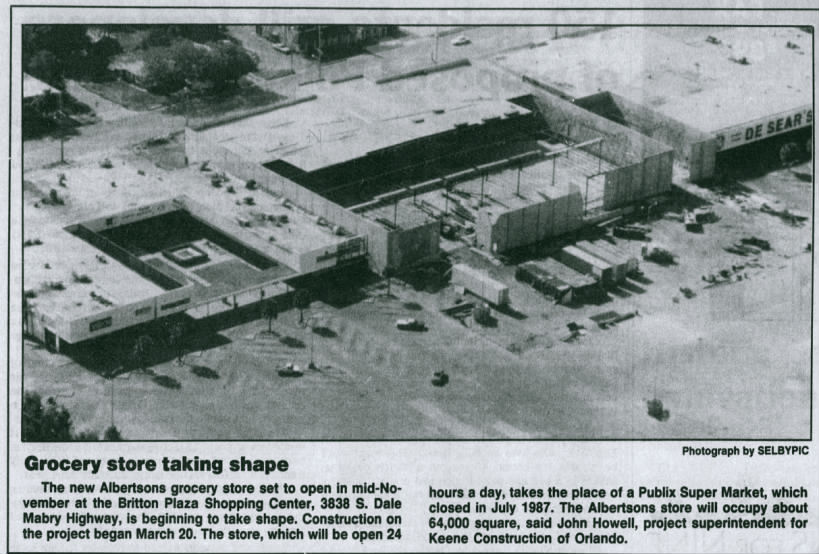
     The last two photos show the new Albertsons shell rising from the ground, located between a part of the shopping center known as "the mall" (to the left of the Albertsons) and the former W.T. Grant's store (home to De Sear's Appliances at the time the above photo was taken, which was a local appliance chain unrelated to Sears Roebuck, who interestingly enough did run an outlet store in Britton Plaza during the same time De Sear's Appliances was in business).

Photo courtesy of a really old real estate listing

     Following the run of 3 different incarnations of Publix at this site, Albertsons #4374 opened for business in late 1989. The new Albertsons was a typical late 1980's Superstore build, featuring the Blue and Gray Market decor and a fairly typical exterior design for the time.

Photo courtesy of a really old real estate listing

     As part of the 1989 refresh to the shopping center, the facade was redesigned to match that of the new Albertsons with its sloped shingle roof. That design runs the entire extent of the original center, with this view showcasing the Albertsons building along with "the mall" to its left.

Photo courtesy of a really old real estate listing

     The trees and other planters we see throughout the parking lot are also a product of the 1989 renovation, which was to make the parking lot look nicer (as until then, it was just a large expanse of asphalt).

Photo courtesy of a really old real estate listing

     Thanks to some information from HR2012TPA, I have been informed that Albertsons #4374 received one interior remodel during its lifespan, remodeling to Grocery Palace ca. 2001-2002, which this store would end up closing with in 2008. While the interior was updated, throughout this store's 19 years in operation, the facade was never altered too much from its original form.

Photo courtesy of a really old real estate listing

     Britton Plaza's famous road sign, as seen during the Albertsons era. Albertsons was the one to add the sign block above the large "BRITTON PLAZA" panel, as Publix's previous incarnations all used a panel on the original sign board located below the center's name (as seen in some of the previous news clipping photos too).


     Come 2008, the Britton Plaza Albertsons was included as one of the 49 Albertsons locations in Florida to be sold to Publix that year. Albertsons closed this store in August 2008 after a 19-year run at Britton Plaza, with Publix officially returning to its former site at Britton Plaza after a two-decade hiatus on January 8, 2009.


     While Publix originally closed at Britton Plaza due to the original store's proximity to other newer Publix stores nearby, the presence of stores #310 and #611 (#17's replacement, which opened during Albertsons' run at Britton) seemed to be a non-issue again. As Publix grew in Florida during Albertsons' time at Britton Plaza, Publix stores were getting more densely packed in some areas, especially urban areas like Tampa. When asked by The Tampa Tribune about the company's return to Britton Plaza and its proximity to stores #310 and #611, a Publix spokeswoman stated "it's not uncommon for us to open a store in close proximity to another. It helps us better serve our customers and relieve congestion." While there is a little bit of breathing room between the Britton Plaza Publix and its counterparts two miles to the north and one mile to the south, we do know there are some more ridiculous examples out there of how closely-packed Publix will place stores these days!


     Following the opening of Publixsons #1307, Publix seemed to have more faith in Britton Plaza the second time (or technically, the fourth time) around. With Britton Plaza's movie theater closing around the same time as Albertsons, the arrival of Publix was seen as a refreshing positive for the shopping center.


Photo courtesy of Wikipedia

     Following Publix's typical repaint of these former Albertsons buildings to a brown color and the installation of Classy Market 2.0 decor inside, this was another one of Publix's relatively cheap conversions of a former Albertsons building.


     Even though the trees were not in my favor, your very own AFB took the above photo of the Britton Plaza Publixsons way back in 2012. At the time I took this photo, inklings of starting an Albertsons-related blog began swirling around my mind, so I figured I'd take a quick photo of this place to keep for the future (although it took me 12 years to get around to posting it!). Sadly, I didn't go inside the Publixsons during this trip to Tampa (as our visit to Britton Plaza was to go patronize a different tenant, and just prior to arriving here I had used up all my begging and pleading for a random supermarket visit on a Sweetbay). I had no idea back in 2012 that Publix had such a vengeance toward these old Albertsons buildings, otherwise I may have tried harder to talk my way into a quick walk through this store too!

Photo courtesy of HR2012TPA

     Thanks to fellow AFB/MFR contributor HR2012TPA, we get a quick glimpse of what the inside of this store looked like, looking across the front of the store. In the background is the floral island near the store's left side entryway, complete with some obvious Grocery Palace decor remnants too.

Photo courtesy of Foursquare

     Thanks to an old photo posted on Foursquare (which, if you haven't heard yet, is shutting down on December 15, 2024 as a mobile app with the web version to follow shortly after), we can catch a quick glimpse of #4374's front end catwalk mezzanine from the floral department (one of the distinctive traits of these late 1980's/early 1990's "Superstore" buildings). Considering I only have two interior photos of this Publixsons and two old exterior photos of it, that can only mean one thing:


     Yep - Publix called in the bulldozers for this store.


     Sadly, Publixsons #1307 was closed on March 14, 2015 to be torn down and rebuilt as a modern Publix store. As a Publix spokesman described this former 64,000 square foot Albertsons store: "The demolition is Publix's way of upgrading the store to customer expectations. It's just a tired building, and it needs to be replaced. Currently it's just over 60,000 square feet. The new store will be just under 55,000 square feet but a whole lot nicer." As described, the replacement store was to be one of Publix's 54M prototypes, roughly 10,000 square feet smaller than the original Albertsons, with a new Publix liquor store to be built alongside too.


     When it comes to the rebuild projects, Publix tries (as much as possible) to reopen the store in less than a year. While this happens in most cases, some recent rebuilds have taken longer than that due to construction material shortages and other disruptions the construction industry has faced of late. However, back in 2015, Publix managed to get their new Britton Plaza store open in just 9 months - an impressive turnaround for the construction of a new supermarket.


     The new Publix store, #1506, and the fifth Publix store to sit upon this land, opened on December 10, 2015, and is the Publix store you will see today visiting Britton Plaza. Finally making it to the present, that ends our really long explanation of the convoluted history of this supermarket. Publix #1506 seems to do just fine too, and the fact this Publixsons was rebuilt as the nicer 54M prototype instead of the default 45M of the time means this store must do better than average, even with the other two Publix stores nearby (which in the time since Publix #1506 opened, includes a 4th area Publix - #1722 on Gandy Boulevard, and a rebuild of #310 as the first of Publix's new top-of-the-line prototype, #1808).

Thankfully I didn't see any bicycles hanging from the arch when I was here!

     Britton Plaza has a long legacy in South Tampa, as some of the anecdotes in the article above show. As such, I felt is was deserving to dig deeper into the history of this store considering the shopping center's storied past and mark on local history. Hopefully you found that long background story interesting, but to move on to the next part of the post, let's take a look at what you'll find at Britton Plaza today:


     While not a shred of Albertsons remains at Britton Plaza anymore, Publix #1506 uses a facade design that is very reminiscent of what a Grocery Palace-era Albertsons would use. While I highly doubt Publix was paying a tribute to their long-gone Floridian competitor in that way (as this is a somewhat common modern Publix facade), the coincidence in facade design is a small plus for what it otherwise a cookie-cutter modern Publix inside.


     Being we're here, we'll take a quick walk around Publix #1506 to make our tour of this former Albertsons site a little more complete. As such, let's head inside:


     As you'd expect from a Publix store built in the 2010's, upon entering and turning to the right, we find the bakery in the front right corner, followed by produce and the deli to the left in the grand aisle.


     A large deli can be found along the right wall, with its complimentary large crowd waiting for Pub Subs out front too (I visited this store around lunch time, and even though the cooler in the middle of the aisle is blocking it, there very much was a lunch rush back there!).


     One of the defining features of a 54M Publix is the large produce department located in front of the deli and bakery area, a little bit of which we can see here.


     Another unique part of the 54M layout is having the wine department located in the back right corner of the store, at the end of the grand aisle.


     From the wine department, here's a nice overview of the store's grand aisle. While the Publix spokesman I quoted earlier wasn't wrong - this store is very nice - it just does have the same charm a scene like this would have.


     Finding ourselves along the back wall, we find the meat and seafood departments following the wine corner.


     Following the meat and seafood service counters, the back wall transitions to the meat coolers, with dairy coolers further down as you get closer to the left side of the store.


     Like most other mid-2010s 54M stores, this location has a drop ceiling over the center grocery aisles. I've always liked this hybrid ceiling design in supermarkets, as it makes for a classier touch than a warehouse ceiling throughout.


     Returning to the front of the store, here's a look across the check lanes, with the pharmacy counter visible in the background.


     Even though this store has been open since 2015, it appears it has yet to receive an Evergreen remodel, as this photo taken in October 2024 still shows the original Classy Market 3.0/Sienna decor in full force.


     The beer coolers can be found in aisle 7 in this store. Those, along with the break in the drop ceiling, signal our transition into frozen foods in the next couple of aisles.


     The pharmacy appears a little closer as we turn to enter the frozen foods aisles:


     Today, there is certainly a lot more than 100 feet of frozen food coolers like the original Publix at this site bragged about! While Swanson's original TV dinners that revolutionized frozen foods have been long since discontinued (outside of the Hungry Man brand - the last vestige of those still sold in American grocery stores), there are plenty of other frozen foods options to fill all these coolers these days!


     Leaving frozen foods, the drop ceiling picks up once again in aisle 10...


     …and stays with us until we get to aisle 13.


     The very last aisle in this store is number 15, home to the remainder of the dairy coolers, as well as white bread and (from the looks if it) raisins.


     Our last interior photo looks across the front end, and it wouldn't be a Tampa Bay-area Publix without some Bucs merch for sale somewhere in the store!


     Back outside, here's another look at the new Publix's exterior, as well as the store's outdoor seating area, which extends along the right side of the building toward the liquor store.


     From the walkway, here's another look across the seating area, where it appears one person was using the tables to eat their lunch.


     The Publix liquor store is at the far right side of the new Publix building, located in the same general area as Albertsons' old liquor store.

     Being we've talked so much about Britton Plaza as a whole, now that we've covered everything we can about Publix and Albertsons, let's take a quick walk around the rest of the shopping center and take in some of the highlights:


     Immediately to the right of Publix was Bealls Outlet (or Bealls, following the new branding), located in the old W.T. Grant's space:


     I happened to find some old photos of some of the shopping center's other anchors too, so I'll throw these in as we walk along the plaza. The photo of the Britton Grant's above is from right after that store opened in 1956. Grant's remained at Britton Plaza until 1975, closing just shy of the chain's complete collapse in 1976. Following the closure of Grant's local appliance chain De Sear's opened in this space. Following the closure of De Sear's, the space became home to Bealls Outlet in the early 1990's. Bealls Outlet remained at Britton Plaza until early 2024, when the store closed, one of a number of closures at Britton Plaza in recent years - a trend we'll be discussing more toward the end of this post.


     As we near the bend in the shopping center connecting to two pieces of the "L" together, we start to see that 1989-era architecture come back, which matched the facade of the old Albertsons building. In the angle of the plaza's "L" we see a (now closed) Tuesday Morning store, which was the original home of Britton Plaza's Big Lots store. Big Lots occupied this space from 1994 until moving to a newly built store on the other side of the plaza in 2003.


     I thought seeing Dollar Tree's logo in red was unusual, the change in color resulting from the theme of most of the signage in the plaza being red (with some exceptions, like Publix's and Marshall's signs).


     To the right of the Dollar Tree is an empty space that housed a Cici's Pizza from 1999 until 2018, and has remained empty since. The reason I was at Britton Plaza back in 2012 was to dine at this Cici's location, so of course I was intrigued to see what became of it:


     Outside of all the furniture and kitchen equipment being removed, the space is still completely in-tact, complete with the wall signage over the old buffet line. Even though Cici's is slowly working on reopening locations that have closed in recent years (particularly ones that closed due to COVID), I don't think this location will be one of them, considering what we'll be discussing in a little bit regarding the future of Britton Plaza.


     While the endless pizza buffet sometimes does have an end, our tour of Britton Plaza has not come to an end yet as we move a few doors down from Cici's to find the former Stein Mart store.


     Stein Mart's space was originally home to J.C. Penney, the largest tenant at Britton Plaza when it opened in 1956. J.C. Penney remained at Britton Plaza until 1976, when the company decided to leave Britton Plaza in favor of a new store at East Lake Mall on Tampa's east side, over 15 miles away. Following J.C. Penney's move, their space at Britton Plaza became home to a furniture store called Unclaimed Freight until 1982, when a dispute between Unclaimed Freight and the landlord over the installation of a new facade lead to the store's closure. Following the closure of Unclaimed Freight, it appears this space may have remained empty until the opening of Stein Mart in 1989.


     Stein Mart closed at Britton Plaza in 2020, following the chain's bankruptcy and subsequent liquidation. The Stein Mart space has remained empty since.


     While standing in front of the former Stein Mart, I spotted an old Fotomat out in the parking lot. You don't see old Fotomat kiosks much anymore, but at least a cobbler found good use of this one!


     Continuing along the strip of stores, we now find former Britton Theater. Originally featuring 2,200 seats, the Britton Theater was the largest movie house in Tampa when it opened in 1956. The proprietor of the Britton Theater was Mr. S.E. Britton, former owner of the land upon which Britton Plaza was built, and in turn, the shopping center's namesake.


     The architecture of the Britton Theater was described as a "modernistic front, with a glass entryway and a radically new marquee, are in keeping with the modern theme of the interior of the building." As for that interior, in addition to all of its seating, it featured such frills as a 60-foot seamless-type screen (the largest screen in Tampa at the time), high-fidelity audio systems, plushbutton reclining seats, 42 inches between seat rows in the lower (main) seating area, and 360 seats in the luxury mezzanine loge. The loge would feature additional amenities such as a TV set in each box for patrons to watch their favorite shows before and after the feature film, and would also permit smoking.


     The Britton Theater remained a single-screen venue until 1973, when it was converted into a triplex, and was expanded again in 1992 to become an 8-screen theater. The theater operated under a string of ownerships through the years (including bouts under local-ownership, as well as stints under General Cinema, Muvico, and Regal through the years too - thank you commenter for that information), and continued to show movies in some capacity until 2017. After 2017, the Britton Theater became the full-time home of Radiant Church, who had originally begun renting space in the theater in 2013.


     The last store we have to see in Britton Plaza's main strip is Burlington, however prior to Burlington, this space began its life as a Belk-Lindsey store:


     "Belk-Lindsey of Britton" was added to Britton Plaza as part of an expansion to the main strip in 1960, becoming a new anchor to the center's already large line-up of stores. Belk-Lindsey remained at Britton Plaza until 1993, serving as the last outpost of the chain in Tampa. Following Belk's closure, their space was promptly re-tenanted (and expanded slightly) to accommodate a new J. Byron's department store. In 1996, J. Byron's was sold to Upton's, and Upton's went out of business in 1999. In 2000, Burlington opened in the former Upton's space.


     As we conclude our tour of the main strip at Britton Plaza, here's a look across Burlington's storefront toward their main entrance.


     Heading back into the parking lot, we find Radiant Church's reuse of the theater's old road sign, which looked like this during the theater's days as an 8-screen cinema.


     Not much further from the old roadside marquee for the theater, we find Britton Plaza's famous arch sign facing Dale Mabry Highway. The arch, original to the plaza's 1956 opening, is a South Tampa landmark, and outside of a few modifications to the sign panels themselves, has remained in mostly original form through the years (some older photos of the arch were seen earlier in this post for comparison). Britton Plaza's sister center Northgate had an identical arch sign when it first opened, and even with all the change and redevelopment Northgate has seen through the years (much more so than Britton Plaza - for now, at least), Northgate's arch still graces drivers along North Florida Avenue to this day too.

     In the background of the arch, we can also see a smaller sign installed for Tapper Pub, a small bar located in "the mall" portion of Britton Plaza, which appears to be as much of a South Tampa institution as Britton Plaza itself!


     Originally part of the large parking lot when Britton Plaza was first constructed, some outbuildings have since been constructed on the edge of the Britton Plaza property near the intersection of Dale Mabry and Euclid, giving the center a slightly more "U" shape in modern times. Of those out buildings, the one closest to the corner of Dale Mabry and Euclid (although it faces Britton Plaza's parking lot instead of either of those roads) is an old Walgreens. Originally located next door to the former Publix/Food World store in the main plaza after taking over Madison Drugs (a Rexall affiliate), Walgreens relocated to this freestanding building in the parking lot in December 1988 to make room for the new Albertsons. Walgreens remained in this building until 2010, when they moved to a new freestanding store with a drive-thru across the street. Pet Supermarket moved into the old Walgreens space by 2013.


     Next door to the former Walgreens is this strip of stores, built on the site of a Frank's Nursery & Crafts (which opened in 1987 and closed in 2001 when the chain pulled out of the Tampa Bay market). The old Frank's building was demolished for the building we see here now in 2002, with tenants Michael's, Marshalls, and Big Lots all opening in 2003.


     All three of those stores remained in place until Big Lots decided to call it quits at Britton Plaza in December 2023, one of approximately 50 stores Big Lots closed in late 2023 as a precursor to the mass closings and bankruptcy filing that came out of the company in the Summer of 2024. With this store closing exactly on the 20-year mark, it seems like the lease for this store expired and Big Lots (or the landlord) chose not to renew it.


     While Michael's logo is already red, Marshall's also managed to squeak by the red-logo requirement throughout Britton Plaza. Big Lots opted to join the red sign brigade though, with another strange take on a common retail logo (although Big Lots old logo had a brief red period, which the original Britton Plaza Big Lots on the other end of the plaza may have accidently pioneered). What's also interesting about this Big Lots was that it was a new-build location for the chain rather than a conversion of an existing retail box (like the vast majority of Big Lots' stores are, and like the original Britton store was). For that reason I should have gone inside this store just to see what a new-build Big Lots of the 2000's was like, but due to time I didn't go inside. Looking at the photos posted on Google, it appears this store wasn't anything too exciting inside, and resembled what you'd find at one of Big Lots' more thorough conversions of the time.


     Returning to the main section of the original Britton Plaza, we find ourselves at "the mall" portion of the center, located to the left of Publix.


     While called "the mall" in the grand opening articles, this part of the center was never a true enclosed "mall" like most people associate with that word. Instead, this portion of the center was called "the mall" because it featured a number of stores surrounding this little courtyard. When Britton Plaza first opened, the mall courtyard featured benches, tropical landscaping, and soft music broadcast over a loudspeaker. While the tropical landscaping islands remain, the benches were long gone and there was nothing to be heard here but the sound cars driving by.


     Back at Publix, that completes our loop around Britton Plaza! Now that my feet are tired from the walk, let's go up to the sky for some aerial images, courtesy of Google Earth and historicaerials.com:


Former Albertsons #4374 - 2023 - The former Albertsons/current Publix building is the dark-gray roofed building on the right side of the image


Former Albertsons #4374 - 2015 - The original Albertsons building seen just prior to its demolition


Former Albertsons #4374 - December 2008 - The building shortly after Albertsons closed but before Publix opened.


Albertsons #4374 - 2007


Albertsons #4374 - 2002


Future Albertsons #4374 / Food World #708 - 1982 - The old Publix/Food World building is located under the word "Material" in the watermark.


Future Albertsons #4374 / Publix #34 - 1969


Future Albertsons #4374 / Publix #34 - 1957 - Britton Plaza in its original form, before the addition next to the movie theater which added Belk came along. Seeing Britton Plaza in original form, before any outparcels were added, that really is one heck of a large parking lot it had!


     Outside of a few hiccups from the failures or perils of some troubled retail chains (like Tuesday Morning and Big Lots) and a surprise closing or two (like Bealls Outlet), Britton Plaza, from the surface, doesn't seem too far gone. However, in March 2024, it was announced that Britton Plaza's longtime owner was looking to put the shopping center on the market, which has sparked concerns among locals that Britton Plaza was in danger of redevelopment. Britton Plaza, at 32.5 acres in a practically built-out portion of Tampa, on the edge of wealthy and gentrifying neighborhoods, is easily seen as a redevelopment target by locals. With developers looking to build new apartment buildings all over Florida wherever they can find space (many times at the expense of retail sites like this one), I understand the local's fears. While nothing official has been announced about the future of Britton Plaza as of the time of this post's publication in November 2024 (as it appears sale process is still ongoing), many rumors are swirling that the current owners aren't renewing leases in order to make the site more attractive to a developer who would want to flatten a good portion of the center for something like new apartments, much like what is happening right now at the old Winn-Dixie Marketplace plaza at Gandy Blvd. and Manhattan Avenue a few miles away. Locals don't seem too happy about the idea of losing Britton Plaza as a shopping destination, and with Britton Plaza acting as the local bus hub for South Tampa, folks relying on the local bus system also fear what losing Britton Plaza could mean too. For now, it remains to be seen what might happen to Britton Plaza with the potential sale, and if we may end up seeing a 6th incarnation of Publix end up somewhere on this property. Hopefully Britton Plaza won't end up being lost to a developer's whims, as with the right ownership, Britton Plaza can continue to serve South Tampa as a neighborhood shopping destination for years to come.

     Hopefully that post wasn't too overwhelmingly long for everyone, but the story of Britton Plaza is quite interesting, somewhat outshining the story of the old Albertsons that was here too! Having an Albertsons at Britton Plaza between the run of all those Publix stores did make overall story of Britton Plaza a little more interesting though - maybe not as interesting to most as the legend of Britton's buried bulldozer, but one of the stranger sequences of supermarkets I've seen researching Floridian shopping centers!

     Next time, more from South Tampa as we explore another somewhat famous store from this area that was also the target of redevelopment greed, but in a different way than the people are fearing will happen to Britton Plaza. We'll see more of that next time, so be sure to come back in two weeks for that!

Until the next post,

The Albertsons Florida Blogger